
Underground utility work increasingly runs through crowded cities, mixed ground, and long crossings. In horizontal directional drilling (HDD), that makes two things essential: knowing where the drill head is, and correcting its direction quickly when it drifts off line.
Unlike open-cut methods, HDD trenchless construction disturbs less of the surface: roads, waterways, traffic, and nearby infrastructure. But the drilling happens underground, out of sight. To keep the pilot bore on its designed path, contractors depend on good guidance data and on operators who know how to read it.
This gets harder where existing utilities are dense, working space is tight, the geology is difficult, or the bore path has strict tolerances. On those jobs, how fast the crew gets locating data, and how well they control the trajectory, feeds straight into safety, bore quality, reaming, and schedule.
Smart magnetic guidance systems address this. They give crews a clearer view of what the bore is doing underground and more control over it.
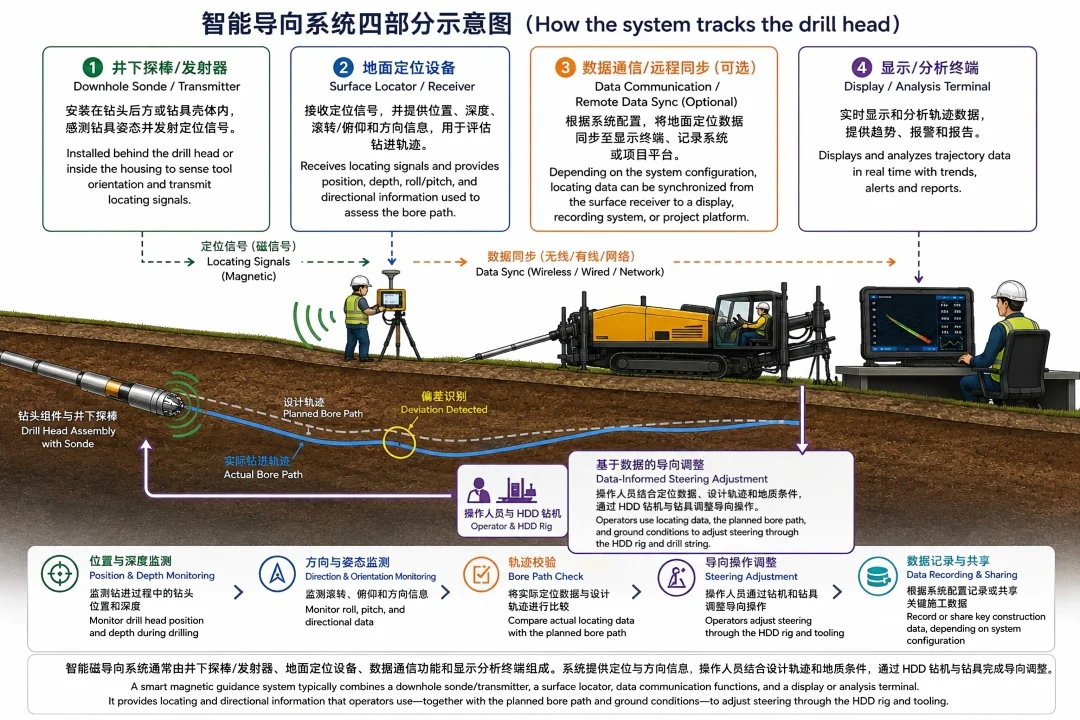
How an HDD Magnetic Guidance System Tracks the Drill Head
A guidance system for HDD usually has four parts working together: a sensing or transmitting unit downhole, locating equipment on the surface, a data link between them, and a terminal that displays or analyzes the readings.
It reads the magnetic field and the tool’s orientation, then turns that into position and direction data for the operator. During the pilot bore, the guidance team watches location, depth, pitch, and changes in direction.
They compare the actual readings against the planned bore path. When the drill head starts to drift off line, the crews adjust tool orientation, steering, or method, based on the data and the ground they are actually in.
In effect, this gives the crew a navigation reference that updates as they drill. It doesn’t replace the judgment of operators, locating specialists, or site managers. It gives them better information to work from and makes the team easier to coordinate.
So the system does more than locate the head. It also supports direction monitoring, trajectory checks, steering adjustments, and passing key information around the crew during the pilot bore.
Better control on difficult crossings
Faster position and direction data lets a crew catch a deviation early and correct it before it grows. A steadier pilot bore means fewer wobbles in the trajectory, less chance of drifting too far off line, and less rework.
The quality of the pilot bore carries into later stages. A bore that holds a good line makes reaming and pipe pullback easier. A bad one, with big deviations or constant direction changes, raises drilling resistance, makes reaming harder, and strains the tools and the rest of the job.
It suits most kinds of trenchless work. On municipal water, drainage, gas, and utility jobs, it helps control the bore path where the ground below is already crowded. On oil and gas pipelines, power cables, and telecom conduit, it helps the crew hold the designed alignment.
On river, highway, and rail crossings, where you often can’t dig and the crossing can be long, dependable guidance data makes the bore easier to control.
How well it performs depends on the geology, electromagnetic interference nearby, the state of the equipment, the tool setup, bore depth, and the operator’s experience. So treat it as one input among several. Read it alongside your site survey, the bore-path design, the drilling parameters, and what you see on the ground, not on its own.
Guidance only works with the right tools behind it
Accurate guidance is only one part of the job. The pilot bit, drill rods, reamers, locating accessories, and the rest have to be chosen and set up for the specific rig, ground, bore diameter, crossing length, and job.
Even with good guidance data, the wrong tool or a badly matched setup will hold back steering and slow the work down. In hard ground, the pilot assembly you pick affects both how the bore responds to steering and how long the tools last. For reaming, the reamer type, the size steps, the connections, and what the drill rods can handle all belong in the plan too.
That’s why more of the industry is buying supported tool packages instead of one part at a time.
We keep a full range of HDD parts in stock and help customers choose them, combine them, and match them to a specific job, based on the rig model and how it will be run. That covers pilot drilling tools, reaming tools, drill rods, guidance accessories, and the supporting parts around them.
Looking at the ground, the size of the job, what the machine can take, and what you’re trying to achieve, we can also recommend a complete HDD package. The aim is to help you pick the right parts. It does not mean we build or manufacture the third-party smart magnetic guidance systems themselves.
Where HDD is heading
HDD keeps getting more digital. As locating data, drilling parameters, equipment records, and site management link up, crews get a clearer read on what is happening underground.
Smart guidance will likely handle more of the bore-path monitoring and decision support. How much it helps still comes down to how well it works with the rig, the tools, the procedures, and the crew.
For contractors and owners, the point isn’t just better locating. It’s a way of working that leans on data, holds the trajectory tighter, and catches problems sooner.
None of that works without a steady parts supply, tools matched to the job, and support from people who understand it. Guidance is worth most when the equipment behind it is right for the ground.
Talk to us
If you need help choosing HDD parts, configuring tools, or putting together an equipment package for a specific job, get in touch. We’ll work out something that fits your rig, your ground conditions, and what the job needs.